Urticaria | Medtick

Urticaria

What is it?

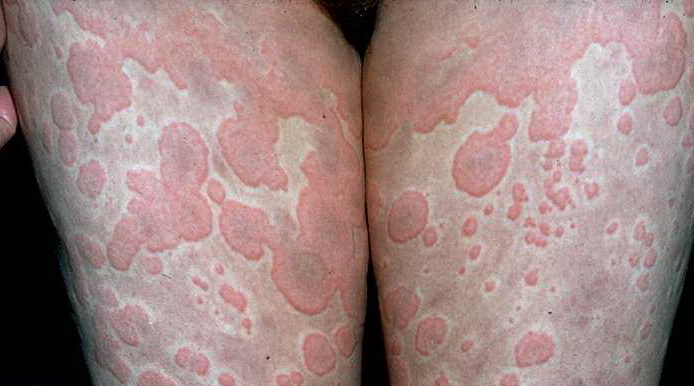
It is a raised, itchy rash that appears on the skin (the epidermis and dermis layers of the skin).

  • It may appear on one part of the body or be spread across large areas.
  • The rash is usually very itchy and ranges in size from a few millimetres to the size of a hand.
  • Although the affected area may change in appearance within 24 hours, the rash usually settles within a few days.
  • It is also referred as as hives, wheal’s, welts or nettle rash.

There are two types:

  • Acute urticaria – if the rash clears completely within six weeks.
  • Chronic urticaria (rare) -where the rash persists or comes and goes for more than six weeks, often over many years.

A much rarer type of urticaria, known as urticaria vasculitis, can cause blood vessels inside the skin to become inflamed.

  • In these cases, the weal’s last longer than 24 hours, are more painful, and can leave a bruise.

NHS choices


Triggers:

The reactions and hormones involved are mast cell activation which release histamine in the body causing symptoms (what causes this activation is still fully unknown), its very similar to an allergic reaction but on the skin causing swelling and hives.

(Antigen is the trigger i.e. medication- see causes)

Schematic diagram illustrating the binding of antigens and cross-linking of immunoglobulin E (IgE)-receptor complexes on the mast cell membrane.

  • This event triggers a cascade within the cell that results in the synthesis and release of leukotrienes and prostaglandins, as well as degranulation, which releases histamine, chemical mediators and other factors.

There are different levels of Long term urticaria:

Level of disease Score Wheals and pruritus
Table 2: Urticaria activity score 7 scale
Symptom free 0 Itch and hive-free over seven days
Well-controlled chronic
spontaneous urticaria (CSU)
1–6 Typically with a mild itch and no hives or <20 hives over 24 hours
Mild CSU 7–15 Typically with a mild itch and <20 hives over 24 hours
Moderate CSU 16–27 Typically with a troublesome itch and ≤50 hives over 24 hours
Severe CSU 28–42 Typically with an intense itch and >50 hives over 24 hours or large confluent areas of hives

Zuberbier T, Aberer W, Asero R et al. The EAACI/GA2LEN/EDF/WAO guideline for the definition, classification, diagnosis, and management of urticaria: the 2013 revision and update. Allergy 2014; doi: 10.1111/all.12313


Diagnosis Tests

Other tests include:

  • Urticaria control test (UCT)
  • Dermatology QoL index (DLQI)
  • Chronic urticaria QoL questionnaire (CU-Q2oL)
  • Skin prick test

Cause

Syndromes

Medication

Vitamin, Herbals and Minerals 

Symptoms

  • New Rash and/or existing rash becoming worst?
  • Wheals red/pink in colour, have a red oval shape and are itchy?
  • Range in size from 2 mm to over 10mm?
  • Existing wheals fade after a few hours and replaced by new ones (some wheals can exist from 8 hours – 12 hours and stop after 24 hours)?
  • Wheals longer than six weeks?
  • Wheals last longer than 24 hours then bruise?
  • Burning sensation in deep layer of skin, common areas are eyelids, lips (angioedema)?

Complications /Information to beware of/General tips:

Do not wait, phone for ambulance if have or develop:


This condition can also lead to:

Beware of:


This condition could be related to:


General tips

  • Take cool showers (not on cold related urticaria)
  • Apply cool compresses (not on cold related urticaria)
  • Wear loose-fitting clothes
  • Avoid strenuous activity

This condition may show similar symptoms to:

Please talk to your healthcare professional (i.e. Medical Doctor/Pharmacist) for further advice

Detailed Information

Please copy and paste any key words from the title: Urticaria in the following respective 'Medtick References and/or Sources' to find out more about the disease (this also may include diagnosis tests and generic medical treatments).

  • Medical News Today

    Medical news and health news headlines posted throughout the day, every day.

  • Medscape (Professional level)

    Latest medical news and expert commentary in your specialty as well as disease information.

  • Healthline

    Medical Information and health advice you can trust

  • EveryDay Health

    Wellness inspired. Wellness enabled.

  • Pharmaceutical Journal (Professional level)

    The Pharmaceutical Journal covers analysis, features, opinion, learning and careers articles, providing insight and knowledge about drugs, pharmacy practice, medicines use and healthcare policy in the context of the pharmacy profession and pharmaceutical science.

  • NHS

    Find information and advice on health conditions, symptoms, healthy living, medicines and how to get help (British National Health Service).

  • WebMD

    Better Information. Better Health.

  • Cleveland Clinic

    Pushing the Standards of care.

  • Mayo Clinic

    No.1 Hospital in the Nation (America)

  • Drugs.com

    Know more. Be sure.

  • National Organisation of Rare Diseases

    NORD is dedicated to supporting education, elevating care, advancing research, and driving policy for rare diseases.

  • Verywell Health

    Know more. Fell better.

  • Nathnac

    Travel health guidance for health professionals advising travellers and for travellers going overseas from the UK.

  • DR Axe

    Health and fitness news. Recipes, Natural Remedies

  • Better health - NHS

    Healthy changes start with little changes. Whether you want to lose weight, drink less alcohol, get active or quit smoking, you have access to lots of free tools and support through Better Health. You can also find simple ways to lift your mood with Every Mind Matters.

    There has never been a better time to kickstart your health. Let’s do this!