Ulcerative Colitis | Medtick

Ulcerative Colitis

What is it?

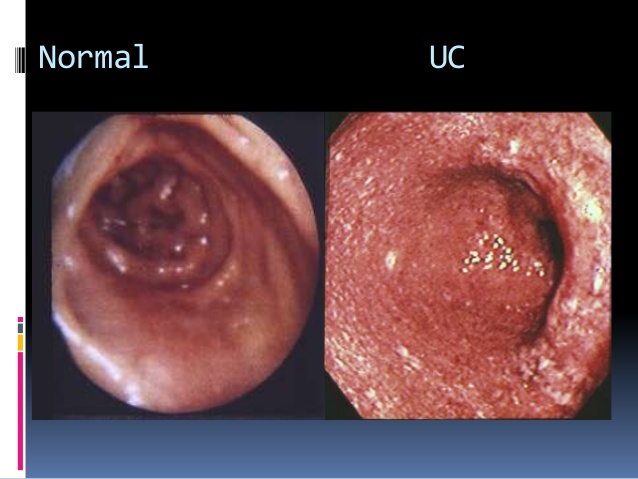
A long term condition that causes hot, red, swelling (inflammation) and in serious conditions ulcers (sores that bleed, produce mucus and pus) on the lining of the large intestine colon.

  • It usually begins in the rectum, then worsens to involve some or all of the large intestine colon.
  • It usually affects person of any gender age 15- 30 years of age and  second peak of incidence of persons of age  50 – 70 years.

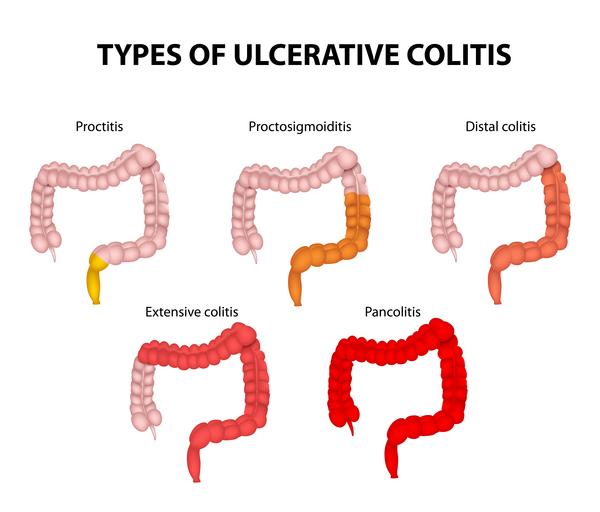
Examples of ulcerative colitis include:

The different forms of ulcerative colitis and their most common symptoms include:

  • Ulcerative proctitis – Inflammation located in the rectum
  • Proctosigmoiditis – Inflammation located in the rectum and sigmoid colon
  • Left-sided colitis (also limited or distal colitis) – Inflammation in the left side of the colon (rectum, sigmoid colon, descending colon)
  • Pancolitis – Inflammation throughout the whole colon

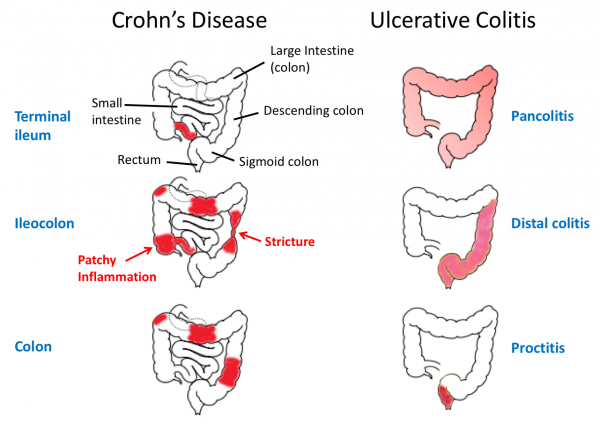
Other types of colitis include:

  • Crohn’s disease
  • Intermediate colitis (mainly in children- difficult to tell what form of IBD it is)
  • Microscopic colitis
  • Diversion colitis – inflamed and dysfunctioning colon.
  • Pseudomembranous colitis is caused by Clostridioides difficile (caused by antibiotics use).

The clinical similarities and differences between Crohn’s disease and Ulcerative colitis are highlighted in Table 1.
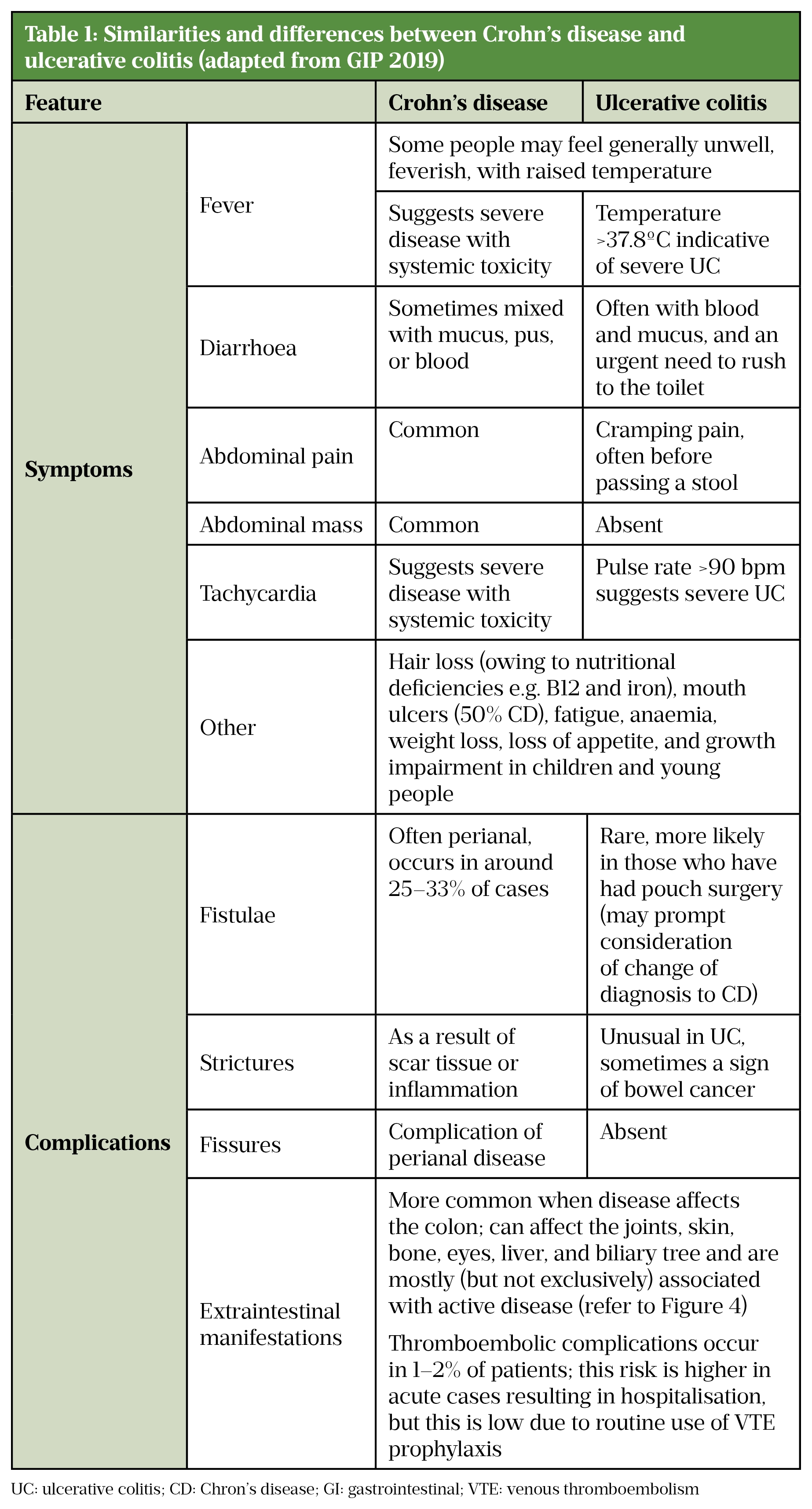
Table 1 Similarities and differences between Crohn’s disease and ulcerative colitis Crohn’s disease: your guide. Crohn’s & Colitis UK. 2019.
https://www.crohnsandcolitis.org.uk/
about-crohns-and-colitis/publications/crohns-disease
(accessed Aug 2021).Ulcerative colitis: your guide . Crohn’s & Colitis UK. 2018.www.crohnsandcolitis.org.uk/about-inflammatory-bowel-disease/publications/ulcerative-colitis (accessed Aug 2021).
Ng WK, Wong SH, Ng SC. Changing epidemiological trends of inflammatory bowel disease in Asia. Intest Res 2016;14:111. doi:10.5217/ir.2016.14.2.111
Crohn’s disease: management. NICE guideline NG129. National Institute for Health and Care Excellence. 2019.
(accessed Aug 2021).
Ulcerative colitis: management. NICE guideline 130. National Institute for Health and Care Excellence. 2019.www.nice.org.uk/ng130 (accessed Aug 2021).
Cripps S. Inflammatory bowel disease: NICE updates advice on remission. Guidelines in Practice. 2019.

Diagnosis tests

Truelove and Witts’ criteria is a useful tool in defining the severity of ulcerative colitis in adults.

Acute severe colitis is defined by more than six bloody stools a day plus one or more of the following markers of systemic upset:

  • Pulse >90 beats/min;
  • Temperature >37.8°C;
  • Haemoglobin <10.5g/dL;
  • Erythrocyte sedimentation rate (ESR) >30mm/h

This condition is a medical emergency and requires inpatient management for intensive therapy.


In such instances, pharmacists should refer patients to their GP or an acute walk-in centre.
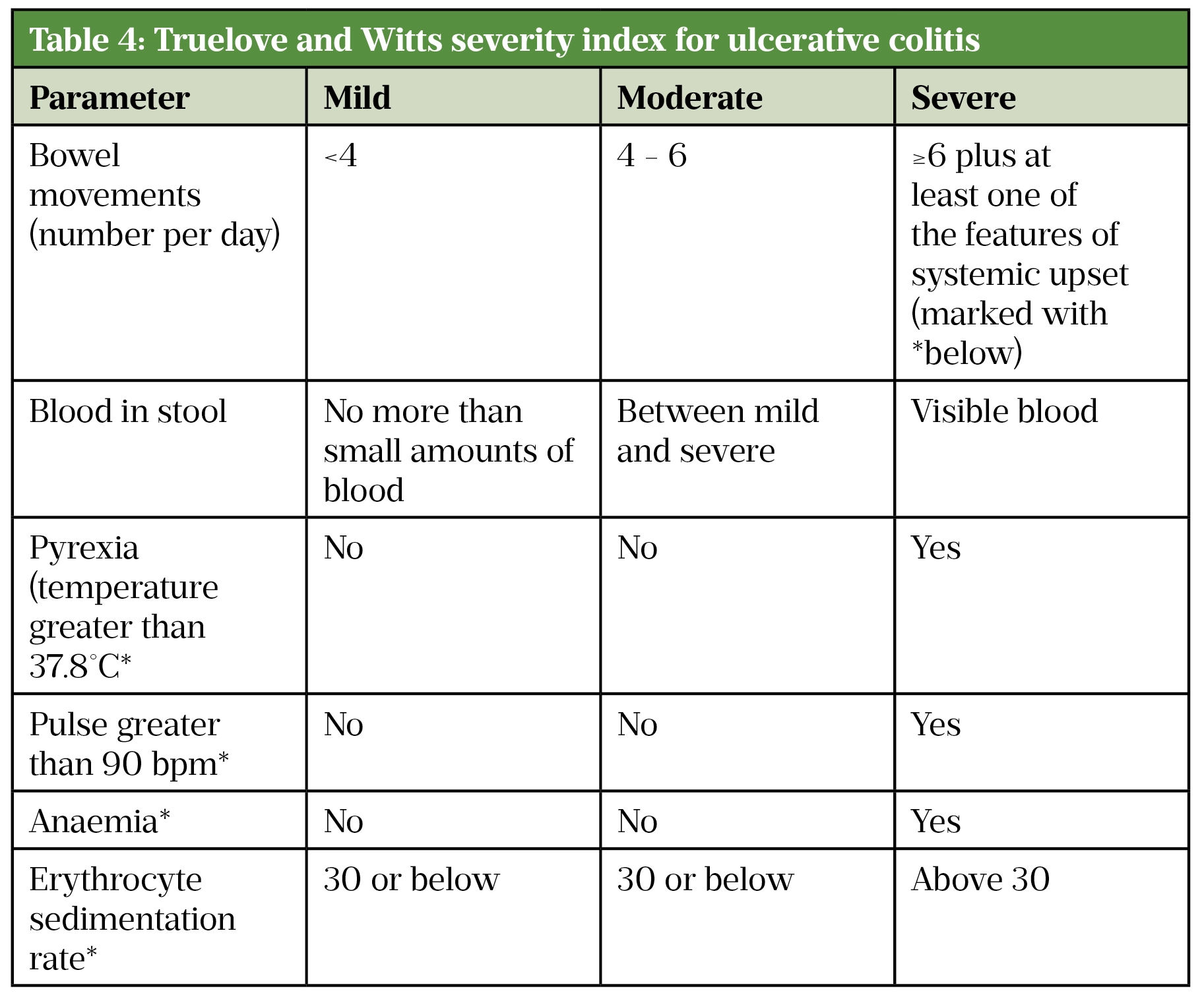
Table 4 Truelove and Witts severity index for ulcerative colitisUlcerative colitis: management. NICE guideline 130. National Institute for Health and Care Excellence. 2019.www.nice.org.uk/ng130 (accessed Aug 2021).
The Pharmaceutical Journal, PJ, August 2021, Vol 307, No 7952;307(7952)::DOI:10.1211/
PJ.2021.1.101504

Other diagnosis tools for grading disease activity and severity of ulcerative colitis

Mayo Score

The Mayo Score for ulcerative colitis activity is a commonly used tool that grades stool frequency (0-3), rectal bleeding (0-3), findings on endoscopy (0-3), and physician’s global assessment (0-3). Endoscopy findings are graded as:

  • Mayo 0: normal or inactive disease
  • Mayo 1: mild disease (erythema, decreased vascular pattern, and mild friability)
  • Mayo 2: moderate disease (marked erythema, lack of vascular pattern, friability, and erosions)
  • Mayo 3: severe disease (spontaneous bleeding and ulcerations)

Rubin DT, Ananthakrishnan AN, Siegel CA, Barnes EL, Long MD. ACG Clinical Guideline Update: Ulcerative Colitis in Adults. Am J Gastroenterol. 2025;120:1187-1224. Source

Ulcerative Colitis Endoscopic Index of Severity (UCEIS)

A tool that determines severity solely on the basis of ranking certain endoscopic descriptors, including vascular pattern (0-2), bleeding (0-3), and erosions and ulcers (0-3).

  • Vascular patterns are classified as: 0, normal; 1, patchy obliteration; 2, obliterated.
  • Bleeding is ranked as: 0, none; 1, mucosal; 2, luminal mild; 3, luminal moderate or severe.
  • Erosions and ulcers are classified as: 0, none; 1, erosions; 2, superficial ulcer; 3, deep ulcer.

The ACG Ulcerative Colitis Activity Index

An extensive tool to help determine disease severity. It includes stool frequency, presence of blood in stool, frequency of faecal urgency, haemoglobin level, ESR, CRP level, faecal calprotectin level, endoscopy Mayo sub score, endoscopy UCEIS score, and intestinal ultrasound.


Diagnosis to differentiate Crohn’s disease from Ulcerative colitis

Serologic markers for Inflammatory bowel disease include most notably Positive perinuclear antineutrophil cytoplasmic antibodies (pANCA) and positive anti–saccharomyces cerevisiae antibodies (ASCA) are associated with Ulcerative colitis and Crohn’s disease.

  • Specifically, pANCA is highly associated with Ulcerative colitis.
  • Positive pANCA and negative ASCA findings suggest Ulcerative colitis.
  • Negative pANCA and positive ASCA suggest Crohn’s disease.

A colonoscopy confirms the diagnosis of suspected Ulcerative colitis, and it is the technique of choice to assess disease activity in patients with symptomatic Ulcerative colitis.

  • In acute-onset (sudden onset) cases of Ulcerative colitis, plain abdominal radiographs are a useful adjunct to imaging.
  • Such images may reveal colonic dilatation in severe cases, evidence of perforation (tear or hole in intestine), which suggests toxic megacolon, ileus, or obstruction.
  • An MRI is useful in the differentiation of Ulcerative colitis from Crohn’s disease, in that fistulae or the presence of small bowel disease are present only in Crohn’s disease.

Medscape

Cause

  • Unknown
  • Family history
  • Association with Escherichia coliSalmonellaCampylobacter and mycobacteria maybe
  • Altered gut microbiota maybe
  • Diet (high in animal fats, sugar and processed foods and low in fruit and vegetables can increase risk of developing IBD or experiencing a relapse)
  • Smoking (though tend to have a milder form)
  • Breakdown in the lining of the intestine and millions of friendly bacteria enter the lining of the wall – this then cause a reaction by the body where  the body own immune system attacks the intestinal wall due to bacteria penetrating into the intestinal wall (autoimmune disease).
  • Familial Mediterranean Fever (FMF)
  • Stress (thought that stress activates inflammatory mediators at enteric nerve endings in the gut wall)
  • Maybe:
    • Air pollution
    • Certain diets
    • Poorer countries exposed to poor sanitation

Medication

Symptoms

(Are worst often first thing in morning)

  • Bloody diarrhoea with mucus?
  • Abdominal pain and/or are constant violently vomiting or vomiting longer than two days (one day if a child)?
  • General discomfort (muscle weakness), uneasiness or ill feeling (malaise) and/or fatigue (tiredness)?
  • Unexplained weight loss?
  • Loss of appetite?
  • Diarrhoea?
  • A desire to empty bowels ( a persistent urge to empty bowels, even when they are already empty) resulting in little or no output?
  • High temperature greater than 38°C (100°F) or over and/or chills and sweats longer than 72 hours?
  • Anaemic (i.e. lack of oxygen in blood, due to lack of iron, folic acid or blood loss)?

Nail changes:

Complications /Information to beware of/General tips:

Medical Emergency Condition

And/or do not wait, phone for an ambulance if have or develop:

  • Severe Dehydration symptoms
  • Peritonitis
  • Septicaemia
  • Toxic megacolon and the risk of perforation (bleeding colon).
  • Primary sclerosing cholangitis -the bile ducts become progressively inflamed and damaged over time (Bile ducts are small tubes used to transport bile ,digestive juice out of the liver and into the digestive system), symptoms include:
    • High temperature greater than 38°C (100°F) or over and/or chills and sweats longer than 72 hours?
    • General discomfort (muscle weakness), uneasiness or ill feeling (malaise) and/or fatigue (tiredness)?
    • Diarrhoea?
    • Itchy skin?
    • Weight loss?
    • Jaundice (Yellow skin colour on skin and whites of eyes (jaundice) that can be itchy, pain over liver area and may have urine darker than normal and may have stools appear pale)?
    • More than six episodes of stools defecate per day and feeling tired  [Hemoglobin level < 10.5 g/dL (showing tiredness and anaemic-type symptoms)] or high fever ( > 100°F (> 37.8°C) and/or fast  and/or irregular heartbeat (Tachycardia – > 90 beats/min) and /or Pulse >90 beats/min.
    • One should be referred to hospital if:
      • More than six bloody stools per day along with Erythrocyte sedimentation rate > 30 mm/h (medical health professional does a blood test)

Other signs of flare up include (but not always):

  • Mild tenderness in the lower left abdominal quadrant (tenderness or cramps are generally present in moderate to severe disease)?
  • Painful and swollen joints (arthritis)?
  • Mouth ulcers?
  • Areas of painful, red and swollen skin?
  • Irritated and red eyes?
  • Emptying bowels more than six times daily?
  • Shortness of breath and/or breathing difficulties?

This condition can lead to and/or be associated with:


This condition can cause a wide range of skin conditions:


This condition may show similar symptoms to:


This condition may show similar symptoms to:

Please talk to your healthcare professional (i.e. Medical Doctor/Pharmacist) for further advice

Detailed Information

Please copy and paste any key words from the title: Ulcerative Colitis in the following respective 'Medtick References and/or Sources' to find out more about the disease (this also may include diagnosis tests and generic medical treatments).

  • Medical News Today

    Medical news and health news headlines posted throughout the day, every day.

  • Medscape (Professional level)

    Latest medical news and expert commentary in your specialty as well as disease information.

  • Healthline

    Medical Information and health advice you can trust

  • EveryDay Health

    Wellness inspired. Wellness enabled.

  • Pharmaceutical Journal (Professional level)

    The Pharmaceutical Journal covers analysis, features, opinion, learning and careers articles, providing insight and knowledge about drugs, pharmacy practice, medicines use and healthcare policy in the context of the pharmacy profession and pharmaceutical science.

  • NHS

    Find information and advice on health conditions, symptoms, healthy living, medicines and how to get help (British National Health Service).

  • WebMD

    Better Information. Better Health.

  • Cleveland Clinic

    Pushing the Standards of care.

  • Mayo Clinic

    No.1 Hospital in the Nation (America)

  • Drugs.com

    Know more. Be sure.

  • National Organisation of Rare Diseases

    NORD is dedicated to supporting education, elevating care, advancing research, and driving policy for rare diseases.

  • Verywell Health

    Know more. Fell better.

  • Nathnac

    Travel health guidance for health professionals advising travellers and for travellers going overseas from the UK.

  • DR Axe

    Health and fitness news. Recipes, Natural Remedies

  • Better health - NHS

    Healthy changes start with little changes. Whether you want to lose weight, drink less alcohol, get active or quit smoking, you have access to lots of free tools and support through Better Health. You can also find simple ways to lift your mood with Every Mind Matters.

    There has never been a better time to kickstart your health. Let’s do this!